




Accurate and Fair Pricing
Pricing is set by the Black-Scholes formula, a framework used across trillions of dollars in derivatives trading. It does not depend on supply or demand from thin orderbooks.
Pricing is set by the Black-Scholes formula, a framework used across trillions of dollars in derivatives trading. It does not depend on supply or demand from thin orderbooks.
Users can make predictions of any size without waiting for orderbook liquidity. Position size is not limited by the availability of sellers or slippage through a thin book.
The winning range takes the market pool. Rewards can grow far beyond traditional prediction market shares, where the maximum return is capped at $1 per winning share.
Bullseye is a price prediction market focused on predicting an asset's price at expiry.
Bullseye uses the Black-Scholes options formula, a pricing model tested across trillions of dollars in options and derivatives markets, to price each prediction range.
Instead of relying on prices determined from trading on an orderbook, Bullseye calculates a clear model price for every supported range using live market price, historical volatility, time to expiry, range boundaries, and quantified risk.
Users are not guessing against thin liquidity, stale quotes, or inefficient orderbooks. Every range starts from a consistent model-driven price.
Entering a prediction does not require a seller to be available. Each range can be priced directly from market data, keeping markets live and accessible.
The winning range receives the market pool, so rewards are not capped by the fixed $1 payout structure used in traditional prediction market shares.
Single-name equities with enough trading history to measure volatility.
Digital assets with active markets and continuous price history.
Energy and raw materials with reliable market pricing.
Gold, silver, and other metals with deep historical price data.
Currency pairs with enough history to quantify volatility.
Broad market indexes with clean price history and defined sessions.
Real price prediction barely exists in today's prediction markets. What exists is orderbook speculation around whatever liquidity happens to be available.
The displayed probability can look active, but the executable size behind it is often too small for serious prediction.
Polymarket and Kalshi are two of the largest names in prediction markets, yet the data still shows thin visible liquidity, weak depth, and slippage risk even for Bitcoin.
If sellers are not available at a fair price, the prediction is not truly open. The user is forced to wait, overpay, or abandon the trade.
A market can show a probability while having very little size behind it. The quote may look usable until a real order pushes through the book.
Thin books create stale quotes, weak depth, and price movement from the order itself. Users end up managing market structure instead of making a clean prediction.

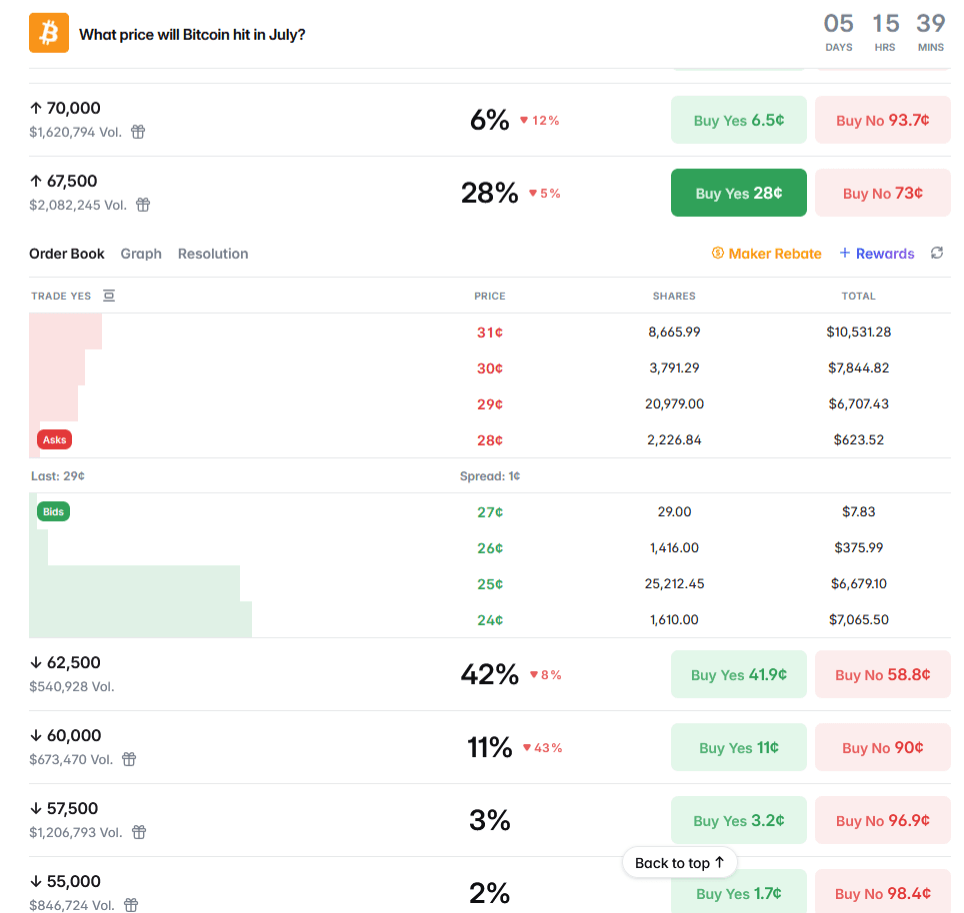
The #1 prediction market in the world had $10.5K available from 28c to 31c. A $10K BTC prediction would push the quote up 10.7%.

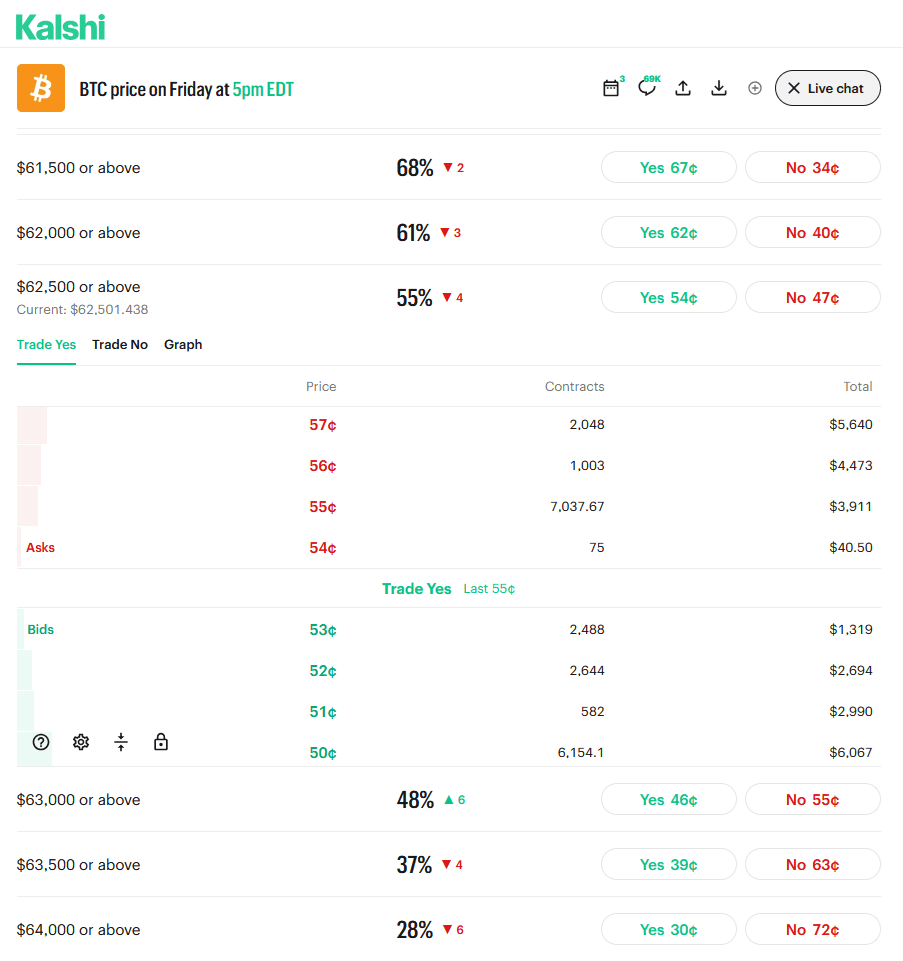
The #2 prediction market in the world had $5.7K available from 54c to 57c. A $5.6K BTC prediction would push the quote up 5.6%.
The world's largest prediction markets have absolutely no liquidity for users to enter in the highest volume crypto asset.
Price prediction is currently broken.
Accurately Priced
Bullseye calculates a clear price for every supported range using live market data. The price comes from the model, not from a thin orderbook.
Orderbook priced
The price comes from trading on an orderbook. Thin books can make prices stale, jumpy, or inefficient.
Orderbook priced
Member bids and asks set the price. If the book is thin, the available price can be worse than the real prediction.
Infinite liquidity to predict
Users can make a prediction on any supported range without waiting for a seller to appear.
Seller dependent
A user can only buy what someone else is willing to sell. Bigger orders can push through weaker prices.
Seller dependent
Quick Orders use what is available in the book. If there is not enough quantity, the order can move to worse levels.
Optional
The orderbook is optional. Users can buy from Bullseye first, then trade tickets later if they want.
The book creates the market
The market depends on buyers and sellers meeting in the book. Without enough activity, price quality suffers.
The book is the market
Members trade Yes and No contracts with each other. Available quantity comes from posted orders.
Unlimited upside
The winning range receives all of the money, regardless of the amount spent to make a prediction on that range.
Fixed $1 ceiling
A winning share pays $1. The most it can pay is fixed before the trade starts.
Fixed $1 ceiling
A winning contract settles at $1. The most it can pay is fixed before the trade starts.
Program terms can change; comparison reflects official documentation reviewed July 2026.
Bullseye creates a market for an asset, expiry time, and set of price ranges.
Every supported range receives a clear price before users make predictions.
Users choose the ranges they believe will win and receive tickets for those predictions.
New predictions stop. Existing tickets can still trade on the optional orderbook.
Bullseye records the final asset price and determines the winning range.
Winning ticket holders claim the pool. If nobody picked the winning range, ticket holders get refunded.
Bullseye prices the probability that an asset expires inside a selected price range.
Each range has a lower boundary and an upper boundary. Tail ranges capture the probability below the first boundary or above the final boundary.
Range probability
Boundary input
finite range: K1 ≤ ST < K2 · current engine uses r = 0
Bullseye uses these inputs to calculate a model price for every supported range.
The current asset price when Bullseye calculates the quote.
How much the asset has moved across recent price history.
The time remaining until the market reaches settlement.
The lower and upper prices that define the selected range.

Sign in with a social account. Bullseye creates the embedded wallet that holds tickets and receives any payout.
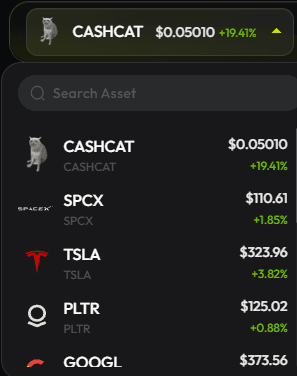
Select the asset and expiry time for the price prediction.
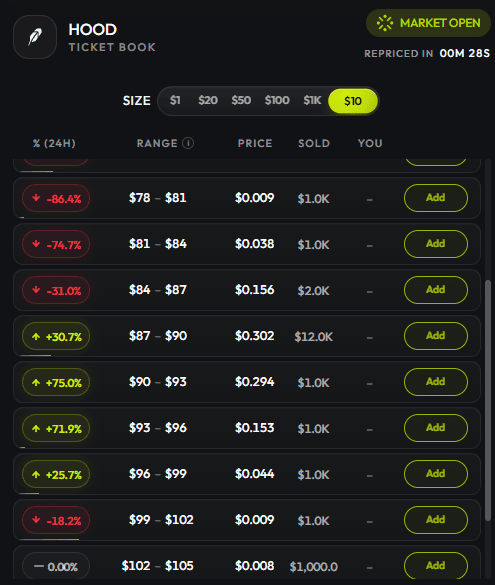
Choose one or more price ranges and enter the ticket amount for each range.
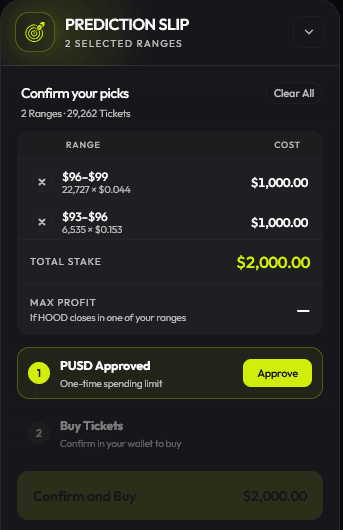
Check the selected ranges, total stake, approval status, and estimated upside before signing.
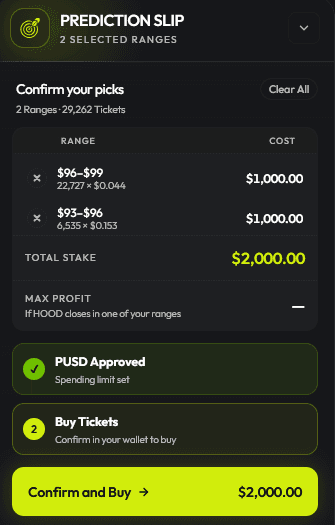
If approval is required, set the spending limit as a separate wallet action.
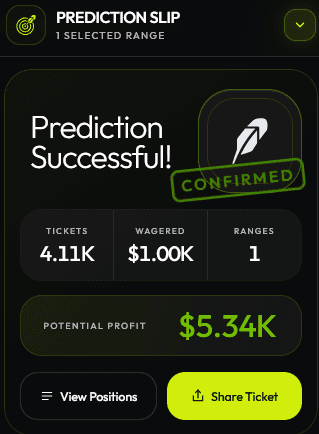
Sign the final buy transaction. The prediction tickets are minted to the wallet once the order is confirmed.
Bullseye features an orderbook for every price range, giving users the option to sell their predictions at a discount to the protocol-set price. The orderbook gives users more flexibility after entry, allowing for swing trading strategies and offering a solution for users who want to manage risk.
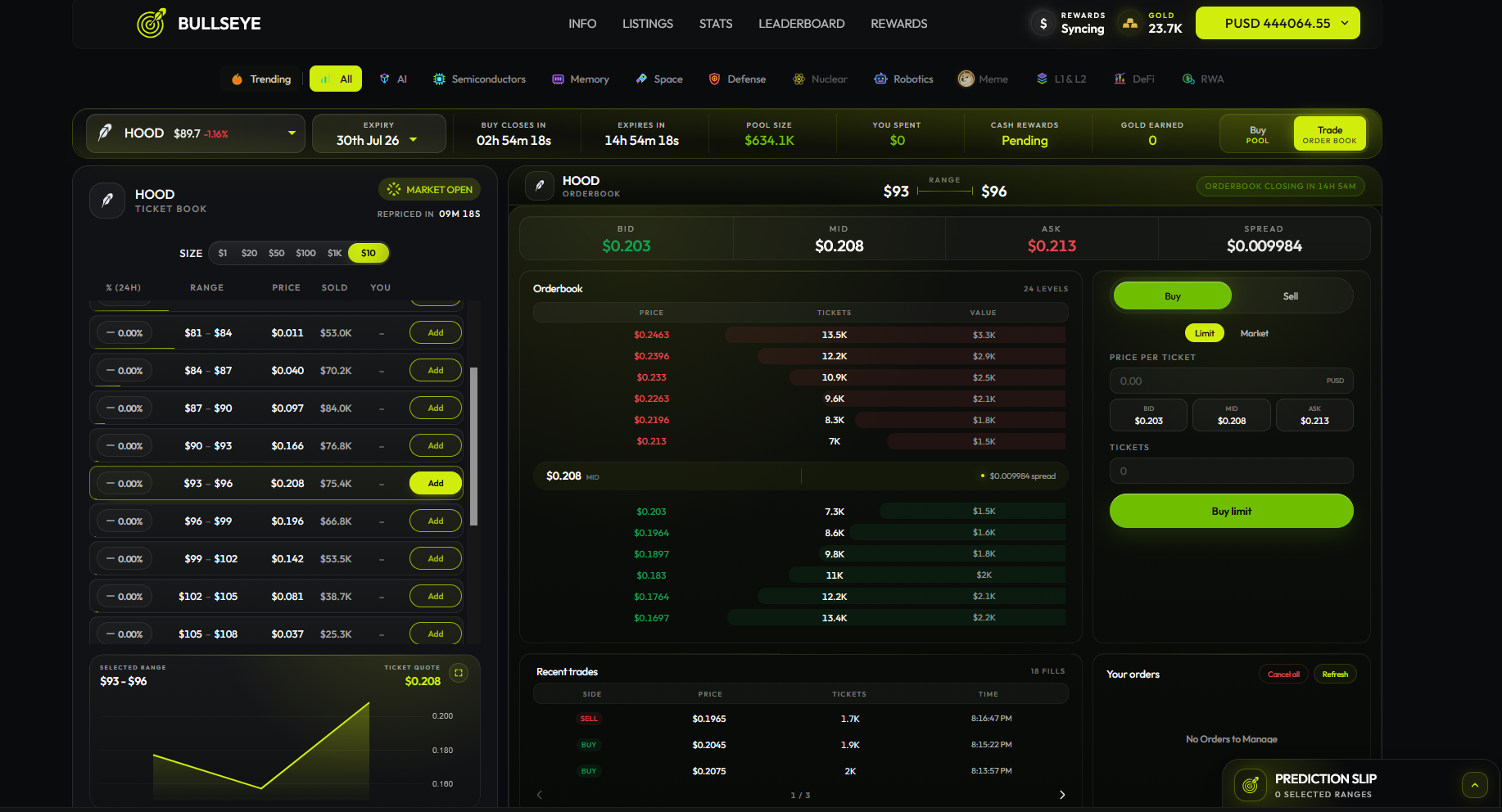
The orderbook improves trading after entry. It does not decide whether a prediction is available.
Creating an order does not move funds or tickets out of the wallet. Transfer happens only when the order fills.
Users can sell tickets, bid for tickets, receive partial fills, and cancel open orders.
When a market expires, Bullseye compares the final asset price with the market ranges and marks the winning range. Tickets in that range become claimable from the resolved market page.
The claim screen turns settlement into a clear action: final range, payout pool, personal reward, and claim button.
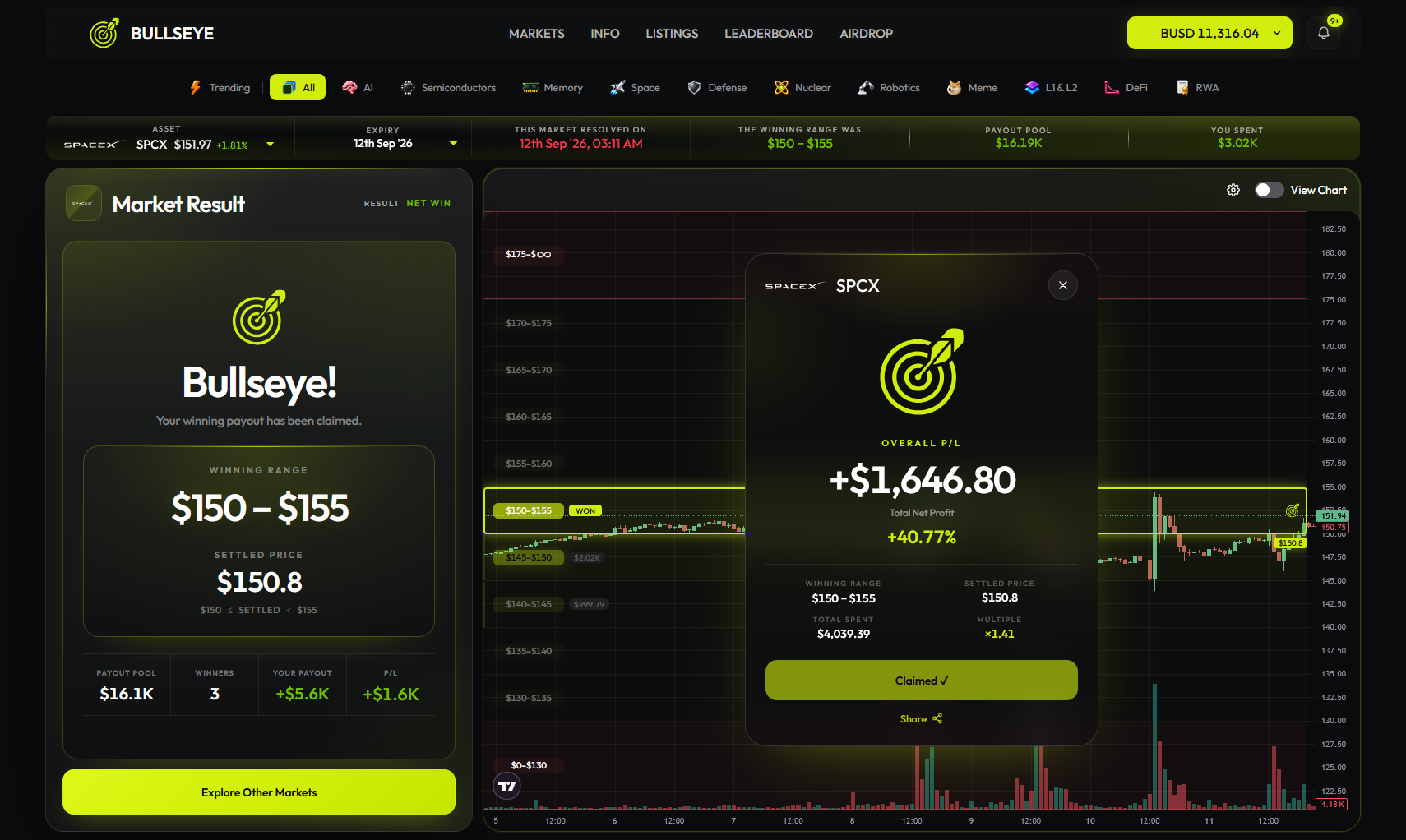
Settlement uses the recorded expiry price to identify the single winning range for that market.
If the wallet holds tickets in the winning range, the resolved market shows the available payout and claim action.
If nobody selected the winning range, eligible ticket holders follow the refund flow instead of a winnings claim.
After years of prediction-market operations, one thing is clear: the current structure does not work for price prediction.
Bullseye is here to disrupt that structure and introduce a new paradigm for price predictions: model-driven pricing, always-available range entry, and user-owned growth incentives.
The goal is to reach the global Web2 audience by abstracting away crypto token management, gas, wallet friction, and complex dApp interactions.
Price prediction should start from market data, not from the limited availability of sellers in a thin orderbook.
Bullseye is designed for a global Web2 audience, with wallets, gas, token handling, and dApp friction pushed behind a simple prediction experience.
Price prediction is universal. Bullseye can serve users anywhere because stocks, crypto, commodities, metals, forex, and indexes are globally understood markets.
Existing prediction markets proved there is demand for speculation. Bullseye is built to unlock the larger category of direct price prediction.